


Fitting family life with academia is not just a question of time, but also money. The road to an academic career is long and precarious—not exactly qualities that conduce to financial security for childrearing. I know this firsthand. My husband and I were both students when our first two children arrived. In a lot of ways, that made things easier; our schedules were more flexible and so we never needed to pay a sitter, for example. But it did pose financial challenges. At the time, I suspected those hurdles were not insurmountable. Now that we’re on the other side of it, I can confirm that this is true. Or at least it was true for us.
So, how did we make it work? We had some support, but mostly we put in a lot of work: hours and hours of online digging, some hindsight, trial-and-error, and dedicated amounts of elbow grease. If I were to sum it all up, I’d say there are three things to know:
What to buy that will save you money;
What purchases will kill 2+ birds with one stone;
What you should not buy that everyone says you need.
I’ll elaborate below, but first let me add a disclaimer. Some money savers require you to overcompensate in other ways; giving up time, for instance. Because of that, my recommendations are probably most feasible for the kind of person I was when discovering them: a graduate student with minimal teaching and administrative duties who had yet to lay down roots, buy a home, and the like. By contrast, the necessary time might be lacking for, say, a researcher also working in industry or a frugal tenured professor in a well-established community.
I should also stress that my focus is only on early parenthood. My eldest is still a toddler, so I can’t speak to costs beyond this stage. Since my little guys are all close in age, as we had hoped they’d be, some of my recommendations have this goal in view. In these cases, what was cheapest for me may not be for you.
#1: The Money-Savers
Diapers
Undoubtedly the greatest recurring material expense is diapers. On the cheaper end of the scale, Amazon sells 30 of their own brand for about $9, which might last you two and a half days with a newborn. More reliable brands will double that cost. And if you’re committed to anything special, such as non-toxic or biodegradable disposables, the options can get really pricey.
Our sympathies were in this direction, but our budget wasn’t. So, we opted for cloth diapers instead (except when travelling, which we learned was a grave error never to be repeated). While I have not kept an accounting, I would estimate that for all three of our children we have probably spent about as much in total as we would have spent on one child in just 3-4 weeks of buying disposables. Yes, the savings are that dramatic. So far, we’re three years in and haven’t had to replace anything yet.
The catches are: 1) that you have to actually deal with solid waste (see below) and; 2) that it can take a very, very long time to wade through all the varieties of cloth diapers (and arguments over them) online. I won’t rehash those debates but will simply get right to the point and tell you which direction we went in after combing through the internet ourselves. We chose to go the prefold route, which is the cheapest option. What this means is that your diaper has two parts, a fabric/plastic outer shell called a ‘cover’ plus a fabric insert, the ‘prefold.’ For the insert, we chose the most absorbent kind of fabric we could find, Grovia’s cotton and bamboo blend. We skipped buying the newborn size, since our pregnancies were normal and so we were expecting babies who could immediately fit into the Size 1s. Originally, we bought Snappi connectors and would fit the prefolds around our baby before putting the shell on, like so:
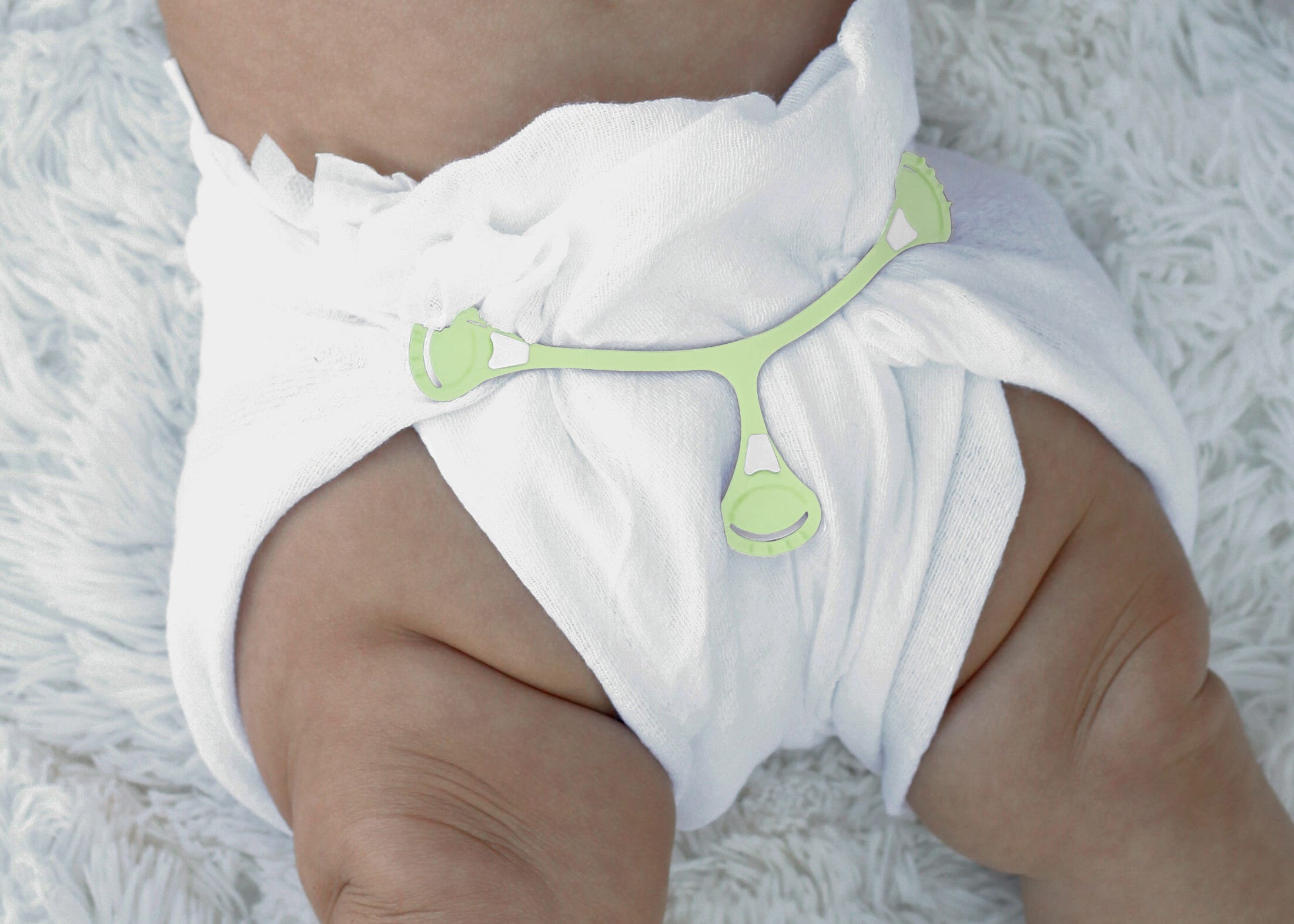
But Snappis are annoying when you’re doing a diaper change in the dark during the dead of night (and feeling half-dead yourself). So we started following the seams to fold the diaper in thirds and then just laid it in the shell. Witness my sloppy handiwork:
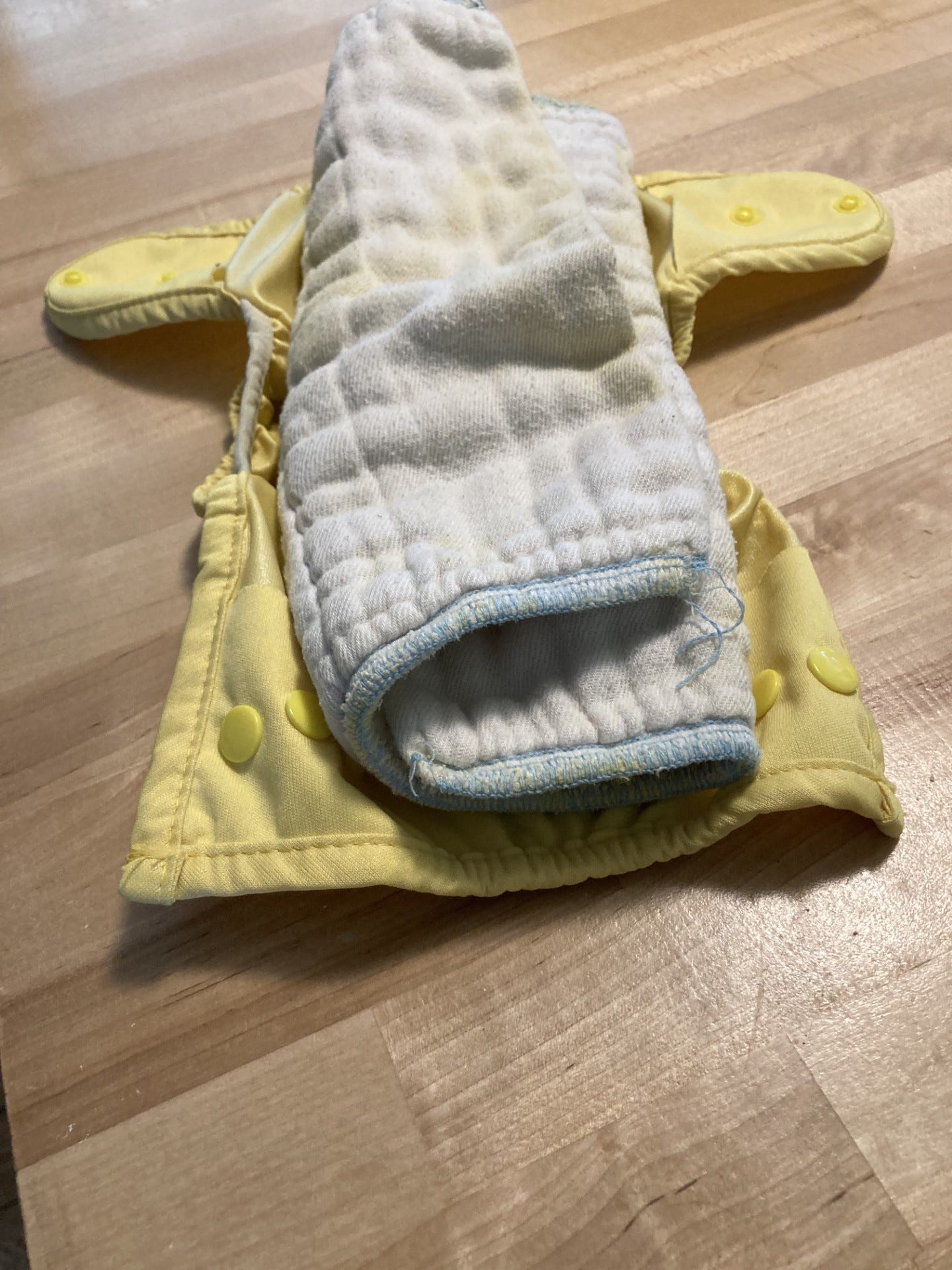
Even barely folded like this, the diaper will be way faster to put on and less prone to leaks if you lay it high up enough towards the front to cover their genitalia. Be sure that no bits of prefold stick out of the cover, either. After the child is something like 1-1.5 years old, we start doubling the diapers at night. To do that, we basically just fold a diaper within a diaper, laying one prefold flat and placing an already folded one in the middle of it before folding the sides of the flat one over. If you’re worried about the bulk of the diapers, don’t be. Babies have wider hips, so these diapers are actually better at maintaining the so-called ‘frog leg position.’
The covers are all functionally similar, if you get the ones with leg gussets (elastics around the leg area). We went with a brand that’s made in America called Thirsties Duo Wraps. Note that most shells, including these ones, have an inner lining that gets destroyed by frequent high heat drying, so you’ll want to air- or sun-dry them most of the time. We hang ours using these space-savers. Thirsties shells, however, require infrequent and short tumbling on low to re-laminate the interior.
Like many brands, Thirsties offers two options, buttons or Velcro, for attaching the shell around your child’s waist. We’ve found the Velcro wears out and doesn’t provide that much more flexibility than the numerous buttons do. Plus, your child can and will tear the Velcro open once they notice it’s within their power to do so. I also recommend resisting the temptation to indulge in all the fun patterns this and other brands offer. Save yourself and buy a solid color that’s different for each size. That way, you won’t need to read the labels to sort your covers when you’re putting them away. Also, be sure to buy a generous amount of dry, reusable wipes, which you can wet with water prior to use. Another money saver—and no endocrine disrupters!
In addition to buying diapers and wipes, you’ll need a few extras to launder them properly. Each cloth diaper brand is compatible with only a specific set of detergents and diaper rash creams. While there’s a lot of overlap across brands, the ones we know work with the abovementioned brands are Tide Free and Gentle detergent and Honest Diaper Rash Cream. Both are widely available at most grocers and pharmacies. When your wee one is a newborn, all you need to do to clean the diapers is toss them in the washer with hot water. You should do this at least every three days; any longer than that and the diapers might develop bacteria that can cause rashes, requiring a bleach treatment.
That means you’ll need at least 3 days worth of prefolds on hand, if not a little more to buy you some leeway. It’s not necessary to purchase the same amount of covers, since you can wipe them down to reuse them if only the prefold has been soiled. That said, I prefer having extra covers on hand to account for the time it takes to air-dry them.
So far, so good. Not much difference at this stage between cloth and disposable diapers. Things get a little more complicated once you transition your child to solid foods. Solid food translates into solid waste, which you’ll have to spray off of the diapers before washing them. For that, you’ll need a bidet sprayer, a spray pail to contain flying feces, and (in our experience) some buckets. We went with this sprayer and have been satisfied with its water pressure. Instead of buying a standard spray pail like this one, we bought a Dollar Tree 2-gallon wastebasket, cut the bottom out, and stored it a slightly larger 2.5-gallon one to catch the liquids that drip from the pail. Note that the wastebaskets should be the same shape so that the smaller one fits inside of its larger counterpart. Also, you should opt for either a rectangular or oval shape; anything that has a flat side against which you can lay the diapers while you spray them. We also have a regular plastic bucket (of any shape) on hand while spraying to carry finished diapers over to our diaper pail or into the washer.
About our diaper pail, we originally purchased an over-priced, extra large one with reusable cloth bags, but it was smelly, leaky, and finicky in the extreme. We have since replaced that system with three 5-gallon Home Depot buckets with lids. Two of the buckets hold the pee diapers, while the third contains the unsprayed poopy ones. The buckets fill up within about 2-3 days between our three kids, one of whom is largely potty trained and another who’s a newborn. When we empty the buckets, we use the sprayer to clean them and then drain that waste into the toilet.
If all of this talk of spraying sounds like too much for you, then I recommend cloth diapering for only the newborn phase or until your child begins solids. It’s as easy as disposables, but a lot cheaper—especially considering that newborns dirty the most diapers. Sure, it adds a bit more laundry, but you’ll already be doing a lot of that anyways with a newborn. You can avoid the tedium of folding by stacking your diapers in plastic bins and throwing your wipes and covers unfolded into separate containers.
Nursing Pads
If your family plans to nurse, the cost of disposable nursing pads can quickly add up. Get yourself reusable ones instead. Like the diapers, we went for a cotton-bamboo blend. This has been the best kind in my experience.
Baby Food
Baby food is highly regulated, which I like to believe is the only reason why an entire cottage industry exists solely to halve the normal proportions of ordinary things and then charge you double for it on the basis that it’s ‘made for babies.’ Indeed, next to diapers baby food is probably the next costliest regular expense. Formula is the worst culprit here, which we used as a supplement only in the very first few weeks with our eldest. For those who need it more regularly, a breastmilk bank is one free option.
Formula is not the industry’s only golden goose. Solid baby food can also get pricey, if you consider how much you’re getting for the amount paid. I have avoided this theft by always making our children’s food. As a consequence, it wasn’t until two of them were toddlers and eating decent portions of regularly sized meals that I started to see a little dent in our grocery bill.
Online, baby recipes for purees, pates, and so on are aplenty. In my experience, at this age kids aren’t that fussy. To get started, all you’ll need is the regular food processor likely already in your possession. To avoid chemical leeching from plastics, I store the food I make in Pyrex glass containers, but you could easily reuse old jam jars and the like for free. If you’re looking for some place to start, nutritionally I recommend this cookbook (some content of which is freely available online here).
You can also save money but making certain ingredients from scratch. Take yogurt for example, a good but relatively expensive baby food item. Making your own yogurt is significantly cheaper than buying it—about five times cheaper, even with an expensive organic and grass-fed milk brand. It’s surprisingly easy to do. If you’re using pasteurized milk, this is a decent recipe. (On the question of how to keep the yogurt warm enough during the incubation period, I have had success with: my mini oven’s dehydrator or the yogurt mode on this Instant Pot at 100 F; my regular oven’s ‘warm’ function; and the oven off but with the light turned on. Only the first of these three options has worked for raw milk, which should be initially heated at or above 110 but not past 118 F). You can also find some bread machines that double as yogurt makers.
After the yogurt is made, I then like to turn it into Greek yogurt by straining it through big cheesecloth bags wrapped around the edges of a deep colander insert that I place inside of a regular stock pot, similar to this contraption—although one could also suspend the cheesecloth in other ways or rest it in a colander. Be sure to drain the whey periodically or else it will rise into the colander. Straining for around 4-6 hours will give you store-bought consistency, although you can always go longer and then add more whey back to make it runnier again. Note that regular yogurt will produce as much milk as you started out with, but Greek yogurt will make roughly 3/4 to 1/2 of that depending on the amount of whey removed.
Although that does make homemade Greek yogurt more expensive, there are ways to make up the cost. Chief among them using whey as starter for your next batch, rather than reserving yogurt or buying more from the store. To do that, simply substitute whey in equal portions for a regular yogurt starter, as called for in your recipe. You can also use whey in other recipes to boost protein content, accelerate fermentation, and the like. For example, I replace water with whey when making homemade breads with my bread machine. The whey’s tanginess preserves the freshness of the bread and gives it a sourdough flavor, making my loaves last longer and cost less than the real stuff! You can also use yogurt whey to make ricotta, referred to in the cheesemaking world as ‘whey ricotta.’ A decent recipe can be found here, although I recommend substituting the milk in this recipe for whey and, if desired, adding cream back afterwards. As the making of whey ricotta also requires straining, you can catch your whey a second time and reuse it in the ways listed above.
Car Seats
You can buy different car seats for each size, or you can get a ‘grow’ car seat to use for all ages. We did the latter, purchasing this one. For the most part, we do not regret it. But I would say that having a regular bucket car seat is really useful for transporting newborns when they’re already asleep, especially if your child isn’t the best sleeper. So, with our second child we added the Uppa Baby Mesa car seat to our collection. We specifically chose this one because it attaches with this connector to the Uppa Baby Vista stroller, which can carry multiple children. When doing that, we put the car seat on the top, a kid in a bucket seat on the bottom, and our eldest on the piggyback board that attaches to the back of the stroller. For reference, here’s a mom from the internet loading her toddler onto the piggyback board:
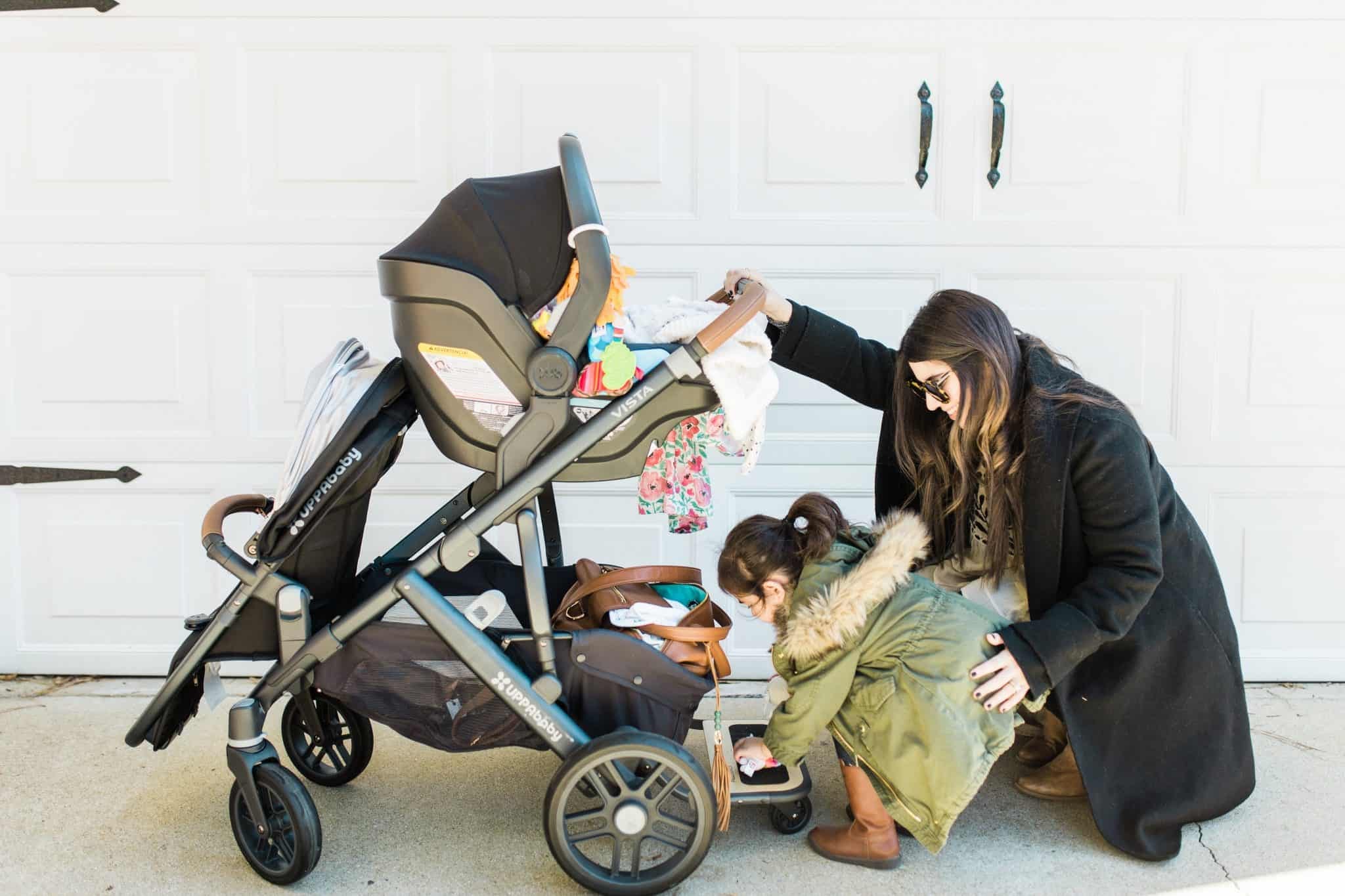
Now, if you know anything about this brand, you might be wondering why we chose it. After all, it’s notoriously expensive. Even so, let me explain why it might still be the cheapest option for families with multiple young children.
Stroller
We planned on having many children close in age, so we were angling for a stroller for multiples. I calculated that it’d be about the same cost if not cheaper to begin with a ‘grow’ stroller—the kind to which seats can be added—instead of buying decent new strollers with each additional child. Also, I wanted a stroller that could fit comfortably through standard sized doors and steer easily (as opposed to really wide double/triple strollers or really long caboose options). If your goal is to fit as many kids as possible, then 3 is the highest number of seats you can obtain while also meeting the abovementioned goals. That leaves you with Uppa and very few alternatives. The cheapest colors the Uppa comes in are $1000 USD. Over time, there will be another $435 in extras to scale the stroller up to a three-seater, which include the following: the second, lower bucket chair ‘Rumble seat’ ($220) and its lower adaptor ($30); the upper adaptor for the bucket seat and/or car seat ($50); and the piggyback board ($135).
The best alternative stroller is the Joovy Qool, which is about half the cost: $500-$650 depending on the model you choose. Here’s the thing, if you buy all the analogues to Uppa’s adaptors plus the accessories with it that are automatically included in the Uppa, it’s $1300 or $1450 (again depending on your model of choice). So they’re comparable, except that Uppa also comes with rain and mosquito covers for each seat, which Joovy doesn’t offer. Additionally, my impression from extensive reviewing is that Joovy doesn’t fold shut very well and is otherwise inferior to Uppa. But if cost is your only consideration, know that you can opt out of some of the Joovy accessories, such as the bassinet, that you can’t with Uppa. Having said that, here’s why you might not want to do that…
#2: Doubling Up Where You Can
If you’re counting costs, then it’s important to prioritize purchases that can cover many bases for you at once.
Bassinet
The Uppa stroller comes with a really nice bassinet that attaches to the stroller, but that can also be freely kept on the floor or laid on a bassinet base ($160—but there might be knock-offs that are cheaper than this). Since you may find the Uppa worthwhile for the reasons already described, consider subtracting the cost of what you would’ve spent on a bassinet from the amount of the stroller.
Nursing-Maternity Clothes
If you or the mother in your family plans to nurse, you should only buy maternity clothes that have nursing capabilities. Why? Because her shape will take a while to come back, if it ever does. Between skeletal changes, uterine swelling, the potential for a diastasis recti bump, and so on, she will look 6-months pregnant for at least 6-months postpartum. So instead of purchasing a whole additional postpartum nursing wardrobe on top of the new maternity wardrobe you just bought, just get maternity clothes that can accommodate nursing.
Nursing and Car Seat Cover
On the subject of nursing, if your family plans to nurse in public, then you may want a nursing cover. There are thousands of options. In my experience, ones like this provide the best coverage, especially once the child is old enough to really wiggle. It also doubles as a stretchy car seat cover that won’t blow in the wind. I chose black to block the sun from baby’s eyes and to maintain the ambient lighting if he’s sleeping while we transition outdoors.
Nursing Chair/‘Maternity Bed’
Nursing chairs are a definite must in our house, but not just for nursing. They’ve consistently been the only thing I can sleep in from the middle of pregnancy until the very end. This might not be true for everybody. But for me, a good portion of pregnancy involves a belly big enough that I can’t sleep on my back, but not so big that it will rest on the mattress when I’m on my side. It just sags, pulling on my hip to such a point that walking can be difficult the next day. To counter this, I’ve tried various pillows—including pregnancy ones like the Snoogle—all to no avail. The only thing that’s worked has been a rocking recliner. We bought a cheap generic one at first, not expecting I’d spend so much time in it before the baby even arrived. When in short order it predictably broke, we splurged on a Lazy Boy. If I could go back, I would’ve splurged at the outset to avoid the duplicative purchase and wasteful pillow vetting.
#3: Pseudo-Necessities to Avoid
Hindsight has taught me that a great number of so-called baby essentials never see a single use. I’ve also learned that some actual essentials will always be provided by others, mainly as the kinds of gifts that people have fun buying. Let me quickly rifle through both:
Don’t buy newborn clothes, except maybe a few outfits for the hospital if that’s where the child will be born. Your wee one will outgrow this size within their first week.
Baby shoes are not necessary until they really start walking independently and often. Before that, they’re just glorified socks. More often than not, they fall right off or become a favorite of your child’s to remove and toss.
If you have private medical insurance, don’t buy a breast pump. At least not without inquiring with your provider first. They might offer you one for free.
Diaper pails aren’t necessary. As mentioned above, Home Depot buckets and lids work better.
We have never used a bottle sanitizer. Instead, we bought dishwasher-safe bottles and put them in the dishwasher or boiled them in a pot.
We also never used a bottle drying rack. A dish towel on the counter has always worked just fine.
Like baby food, baby food processors are another cottage industry item. A regular food processor will do the trick. In fact, it’s bigger so you can make more food at once and freeze it for later.
Everyone will constantly buy you toys and books, so you really don’t need to purchase a lot of these yourself, unless you feel strongly about their use/content. Even if nobody buys you any toys, your children will constantly repurpose ordinary objects for play. They love wearing other people’s shoes, poking people’s eyes out, rearranging all the things in all your cabinets, climbing dangerous items, and so on. More often than not, the only person touching the bulk of the toys is you, and that’s to put them away after your children, in the span of a few short minutes, redecorated your entire house with them in the most chaotic fashion possible.
Conclusion
Make no mistake, parenting on the cheap is a tour-de-force, but one that I hope feels a little more within reach after reading this. Yes, it is hard, but it can work out for the best. It certainly did for me. Having kids in grad school rounded out my education and forced me into a healthier relationship with my work early on. It also gave me the chance to find my feet in the most important area, family life, before starting down the windy road that is a career in academia.